


Varna Archaeological Museum
Варненски археологически музей
Worth a detour
The Varna necropolis turned up by accident in 1972, when a man digging a cable trench on the edge of town cut into a grave. What came out — around three thousand gold objects weighing some six kilogrammes — is the oldest technologically worked gold anyone has found, made roughly between 4600 and 4200 BC. The rest of the museum is a competent provincial collection; the gold rooms are what you are paying for.
Story
Background
The find was made in October 1972 in Varna's western industrial zone, by a digger operator called Raycho Marinov who noticed flint and metal in the spoil. Excavation uncovered a cemetery of the Varna Chalcolithic culture, later dated by radiocarbon to the second half of the fifth millennium BC.
What makes it matter is not the weight but the distribution. A handful of graves hold almost everything; most hold very little. That is a society already sorting itself into ranks, more than a thousand years before the first Egyptian pyramids. Grave 43 is the famous one — long described as a chieftain's burial, more recently argued to be a metalworker's, which would be its own kind of statement about who mattered. Several graves contain no body at all, only a clay mask laid where a face would be.
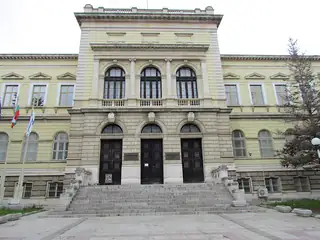
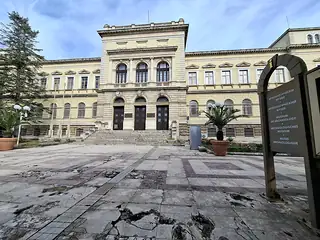
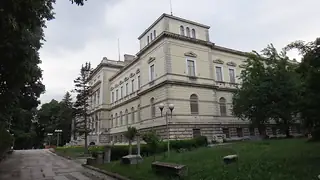
The building was put up between 1892 and 1898 as a girls' high school, to a design by Petko Momchilov, and the museum moved in during 1983. The rooms are plain and the labelling is sparse, so it helps to know what you are looking for. Adults pay about €10 and students about €4; in winter the doors stay shut on Sundays and Mondays.
What this kind of place is
Museum
Bulgarian museums outside the capital often keep short hours, close one day a week — Monday most commonly — and shut for lunch. Labels are frequently Bulgarian-only in the smaller ones, and a good many charge separately for the right to photograph.
From open data
Dates and details
- Built
- 1906
- Part of
- 100 Tourist Sites of Bulgaria
- Municipality
- Varna
English Wikipedia
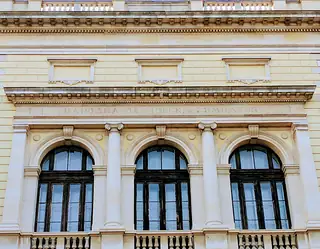
The Varna Archaeological Museum is an archaeological museum in the city of Varna on the Black Sea coast of Bulgaria. Founded on 3 June 1888, when a museum, part of the City Library was established, the Varna Archaeological Museum is situated in a historic building designed in the Neo-Renaissance style by the noted architect Petko Momchilov and built in 1892–1898 for the Varna Girls' School. It became state property in 1945, and since 1993 the museum has occupied the entire building, parts of which it had been using since 1895.
English Wikipedia · CC BY-SA 4.0
Photographs
Where the information comes from
About & sources
Last checked Sep 17, 2026
Descriptions, recommendations and the audio scripts are written for this guide.
Report a problem


