


Thracian tomb Ostrusha
Оструша

Worth a detour
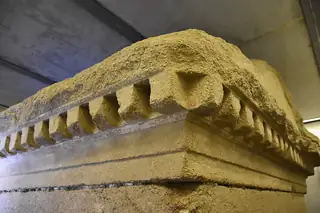
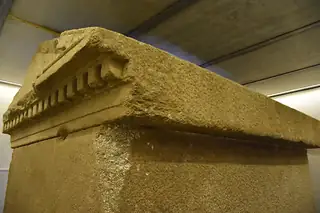
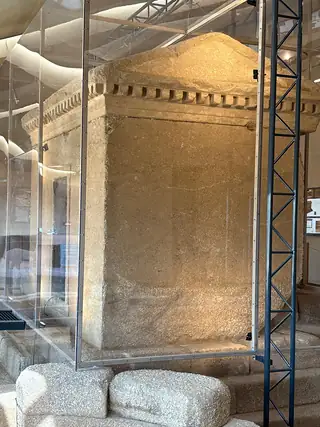
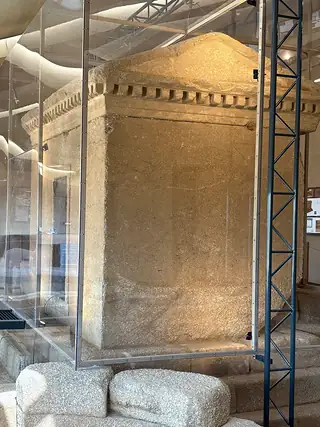
The central chamber here was hollowed out of one block of stone weighing around sixty tonnes, and roofed with a second monolith carved on the outside as a Greek temple roof. The underside of that roof is divided into coffers, each painted. It is a twenty-minute stop on the Kazanlak tomb circuit, and the engineering is as remarkable as the painting.
Story
Background
Ostrusha was excavated in 1993, under a mound more than eighteen metres high in the belt of tumuli between Shipka and Kran that gets called the Valley of the Thracian Kings. What came out was not a single chamber but a complex of six rooms over about a hundred square metres, built in the middle of the fourth century BC — the period when the Odrysian aristocracy was at its wealthiest and most Hellenised.
The centrepiece is a sarcophagus-chamber carved out of a single monolith, sealed by a second stone cut on its exterior into the pitched roof and tiles of a Greek temple. Moving and shaping stone on that scale in the fourth century BC, up a hillside, is the part that stops people. The inner face of the roof block is laid out as a coffered ceiling, each coffer painted with portraits, human scenes, animals in combat, plants and geometric ornament.
Much of that painting has gone. What survives best is a small head of a woman with long brown hair, gold earrings and a necklace, executed with a delicacy that belongs to the same world as the Kazanlak frescoes a few kilometres away. It has been studied hard precisely because so little Hellenistic panel-scale painting survives anywhere. Go in knowing the chamber is small and the light is low; what you are there for is one face and one very large stone.
What this kind of place is
Thracian burial mound
A burial mound raised over a tomb, most of them between the fifth century BC and the Roman period. Bulgaria has somewhere between fifteen and sixty thousand of them, which is more than any other country in Europe, and the great majority have never been excavated. What you see is usually a grassy dome three to fifteen metres high in the middle of farmland, with no sign and nothing to enter.
From open data
Dates and details
- Part of
- royal necropolis of Seuthopolis
- Municipality
- Shipka
- Height
- 18 m
English Wikipedia
The Ostrusha mound is a Thracian burial tumulus near the Bulgarian town of Shipka. It was constructed in the middle of the 4th century BCE. The stone structures under the more than 18 meters high mound form one of the biggest representative tomb-cult complexes with 6 rooms on an area of 100 square meters.
English Wikipedia · CC BY-SA 4.0
Photographs




Where the information comes from
About & sources
Last checked Sep 17, 2026
Descriptions, recommendations and the audio scripts are written for this guide.
Report a problem