


Thracian Tomb of Sveshtari
Свещарска гробница

Worth a detour
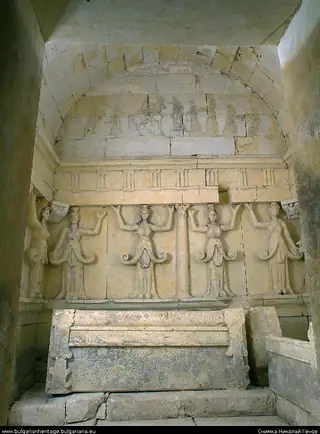
Ten caryatids carved in high relief, half woman and half plant, still carrying their original ochre and blue — an idea that appears nowhere else in Thracian building. The chamber is small and you are in it briefly, in a group, behind a barrier. Come in the same trip as Demir Baba Teke or the journey is a lot of driving for twenty minutes.
Story
Background
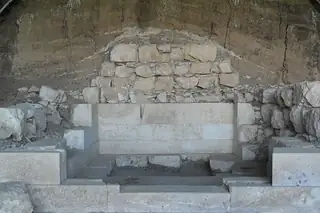
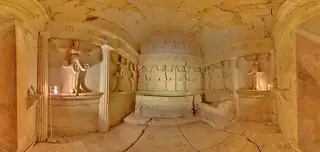
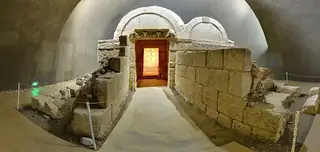
Under Mound Seven of the eastern necropolis at Sboryanovo, opened in 1982, is a tomb from the first quarter of the third century BC: a corridor and three limestone chambers, barrel-vaulted, with Ionic half-columns and a frieze of stylised ox skulls and garlands.
The caryatids are what makes it singular. Ten female figures stand against the wall of the burial chamber, arms raised to the ceiling, their dress opening downward into an inverted palmette so that each woman turns into a plant at the waist. Ochre, brown, blue, red and lilac survive on them. Above, a painted lunette shows a rider being crowned by a goddess. Nothing comparable has been found in Thracian territory, and the working assumption is that this is the grave of a Getic king — Dromichaetes is the usual candidate — buried with a wife who was a daughter of Lysimachus.
What you visit is a concrete protective shell under a rebuilt mound, so there is nothing romantic about the approach. Inside, the climate is regulated to a standard set by the heritage institute, which is why groups are small, timed, and led. Shoe covers are issued and cameras stay in your bag. The rest of Sboryanovo — forty-odd mounds, the site of the Getic capital, the Alevi shrine at Demir Baba Teke — is open and free to wander, and thinly explained.
What this kind of place is
Thracian burial mound
A burial mound raised over a tomb, most of them between the fifth century BC and the Roman period. Bulgaria has somewhere between fifteen and sixty thousand of them, which is more than any other country in Europe, and the great majority have never been excavated. What you see is usually a grassy dome three to fifteen metres high in the middle of farmland, with no sign and nothing to enter.
From open data
Dates and details
- Municipality
- Razgrad
- Heritage status
- World Heritage Site
- Area
- 6.5 km²
English Wikipedia
The Thracian Tomb of Svestari is 2.5 kilometers (1.6 mi) southwest of the village of Sveshtari, Razgrad Province, which is 42 kilometers (26 mi) northeast of Razgrad, in northeast Bulgaria. The tomb is probably the grave of Dromichaetes who was a king of the Getae on both sides of the lower Danube (present day Romania and Bulgaria) around 300 BC, and his wife, the daughter of King Lysimachus who was a general and diadochus (i.e., "successor") of Alexander the Great. The tomb is a UNESCO World Heritage Site.
English Wikipedia · CC BY-SA 4.0
Photographs




Where the information comes from
About & sources
Last checked Sep 16, 2026
Descriptions, recommendations and the audio scripts are written for this guide.
Report a problem