


Thracian Tomb of Kazanlak
Казанлъшка гробница
Worth a detour
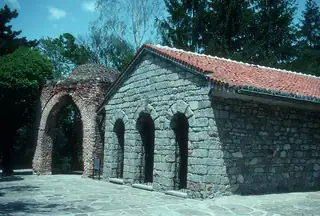
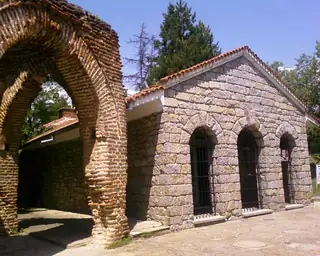
The frescoed frieze of a funeral feast — a couple holding hands as they part — is among the finest surviving Hellenistic painting anywhere. You see it in an exact replica; the original next door has been sealed so that it survives at all. Ten minutes covers the visit, so pair it with Golyama Kosmatka up the road, where the tomb you enter is the real one.
Story
Background
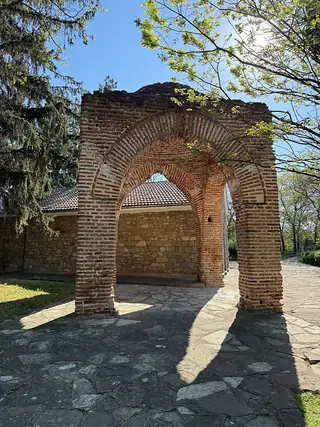
Soldiers digging an air-raid shelter on the edge of Kazanlak broke into it on 19 April 1944. What they had found was a brick tomb from the end of the fourth century BC: a corridor, a small rectangular antechamber, and a round chamber under a beehive dome barely two and a half metres across and three and a quarter high.
The painting runs round that dome in two bands. The lower one is the reason the tomb is famous — a funeral feast, with a Thracian nobleman in a gold wreath seated on a low couch and his wife on a high chair beside him, their hands joined. Servants bring a tray; a boy carries a cup and jug; two women play; grooms lead saddled horses away. Above it, on a narrower band, chariots race. Four colours do all of it: black, red, yellow and white, laid on wet plaster and finished in tempera. The antechamber has battle scenes instead.
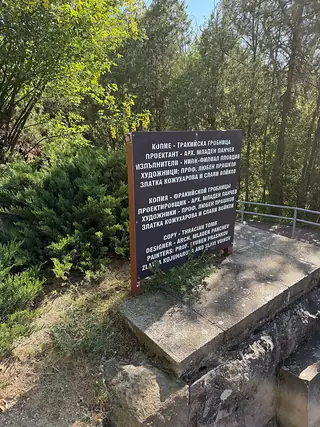
You will not see any of this in the original. That building is locked and climate-controlled a few metres away, and UNESCO's own assessment endorses keeping it that way, pointing visitors to the copy instead. The replica is exact and the visit takes about ten minutes, which is a thin outing on its own — pair it with Golyama Kosmatka a short drive west, where the tomb you walk into is the real one.
What this kind of place is
Thracian burial mound
A burial mound raised over a tomb, most of them between the fifth century BC and the Roman period. Bulgaria has somewhere between fifteen and sixty thousand of them, which is more than any other country in Europe, and the great majority have never been excavated. What you see is usually a grassy dome three to fifteen metres high in the middle of farmland, with no sign and nothing to enter.
From open data
Dates and details
- Part of
- History Museum "Iskra" Kazanlak
- Municipality
- Kazanlak
- Heritage status
- World Heritage Site
- Area
- 7.1 ha
English Wikipedia
The Thracian Tomb of Kazanlak is a vaulted-brickwork "beehive" (tholos) tomb that is located near the town of Kazanlak in central Bulgaria. The tomb is part of a large royal Thracian necropolis in the Valley of the Thracian Rulers near their ancient capital of Seuthopolis in a region where more than a thousand tombs of royalty and members of the Thracian aristocracy can be found. It lies in the Kazanlak Valley, enclosed between the Balkan Mountains to the north and the Sredna Gora mountain range to the south.
English Wikipedia · CC BY-SA 4.0
Photographs
Where the information comes from
About & sources
Last checked Sep 17, 2026
Descriptions, recommendations and the audio scripts are written for this guide.
Report a problem


