


Shumen Plateau Nature Park
Шуменско плато

Worth a detour
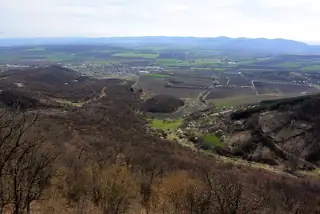
A limestone plateau of just under 4,000 hectares directly above Shumen, declared a park in 1980. It holds the Bukaka reserve of Balkan beech, karst caves, rock-cut monastic cells from the medieval period, the ruined fortress on its southern spur — and, on the rim, the enormous Founders of the Bulgarian State monument. A good half-day that combines walking with two very different kinds of history.
Story
Background
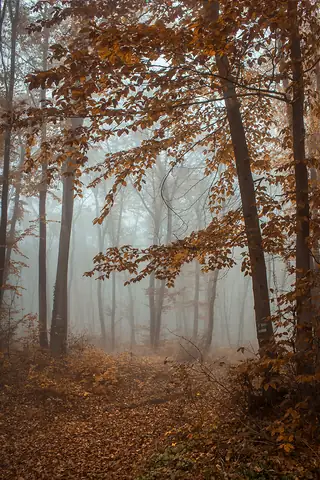
The plateau is the eastern end of the Shumen heights, a block of limestone with steep edges and a flat, wooded top, and it has been used for as long as people have been in this part of the country. Karst has cut caves and cells into the escarpment, and during the Second Bulgarian Empire some of those were occupied as rock monasteries — small religious communities living in the cliff face. The Bukaka reserve on the plateau protects an indigenous stand of the Balkan variety of common beech.
The thing you cannot miss is the monument. Conceived in 1977 as part of the preparations for the 1300th anniversary of the founding of the Bulgarian state in 681, begun in August 1979 and opened on 28 November 1981, it is a mass of angular concrete and mosaic on the plateau edge, carrying colossal figures of the early khans and rulers. It is visible from most of Shumen and from a long way out on the plain. Like the other late-socialist monuments of that anniversary it divides opinion sharply: overbearing state propaganda to some, one of the more ambitious pieces of monumental design in Europe to others. It is maintained and open, unlike Buzludzha.
The practical shape of a visit is to take in the monument, walk a stretch of the plateau rim, and drop down to the fortress on the southern spur. Late afternoon light over the plain is the best of it.
English Wikipedia
The Shumen Plateau Nature Park is located in the Shumen Plateau of the northern province of Shumen of Bulgaria, the highest plateau of the Danubian Plain. The Park encloses the Bukaka Reserve Forest, which is known for indigenous Fagus sylvatica (common beech) moesiaca (the Balkan beech) forest.
English Wikipedia · CC BY-SA 4.0
Photographs




Where the information comes from
About & sources
shumenskoplato.bg · 2
Last checked Sep 17, 2026
Descriptions, recommendations and the audio scripts are written for this guide.
Report a problem