


Rusokastron
Русокастрон

Worth a detour
On the eighteenth of July 1332 the Bulgarian tsar Ivan Alexander destroyed a Byzantine army under the emperor Andronikos below this hill. The fortress on top was built in the fifth century on a natural rock height, held the Erkesia frontier in the ninth and tenth, and was razed by the Ottomans in 1443. Walls two and a half metres thick enclose about fifteen decares. It is free and it is twenty kilometres from Burgas.
Story
Background
The height commands the roads of north-eastern Thrace and the eastern passes of the Balkan range, which is why it was fortified. The earliest written trace is a sixth-century inscription dedicated to a Byzantine commander named Justin. The Arab geographer al-Idrisi is the first to use the name Rusokastro, describing a large and crowded town; Byzantine chroniclers pick it up in accounts of the fourteenth century.
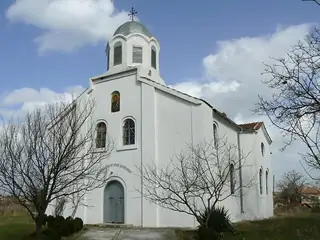
What has been uncovered since digging began in 2006: the foundations of the walls, the inner citadel, a tower chamber, a dwelling and a great deal of domestic pottery. Of the great twin-leaved gate only the left half survives, and the excavators say it has no parallel in Bulgaria; it had drop-grilles. Underneath is a Thracian sanctuary — four semicircular niches shaped as offering altars were found at the entrance in 2006 and dated to the eighth century BC, and two sacrificial stones with carved basins mark the path to the Rusina Dupka cave and its small holy spring. A monastery of St George stood inside the walls from the fifth or sixth century; a church of the same dedication was rebuilt on the spot in 2007.
The difficulty is finding it, and official sources do not help: the national register says half a kilometre east of the village, the municipality says three kilometres north on a high hill with the river round it on three sides, and Wikipedia says north-west. All agree the approach is a dirt track or a path cut in the rock from the south. Ask in the village.
What this kind of place is
Archaeological site
A place where material remains have been recorded. In Bulgaria that can mean anything from a scatter of Roman pottery in a ploughed field to a walled city under excavation. Unless a site has a ticket office, assume there is no sign, no path and no shade.
From open data
Dates and details
- Period
- Byzantine
- Municipality
- Kameno
Photographs




Where the information comes from
About & sources
Last checked Sep 17, 2026
Descriptions, recommendations and the audio scripts are written for this guide.
Report a problem