


Pobiti Kamani
Побити камъни

Worth a detour
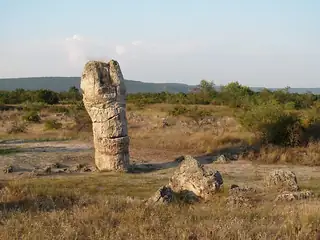
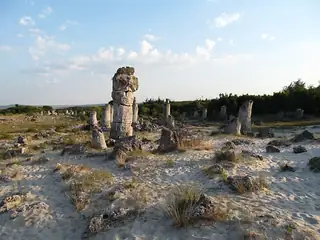
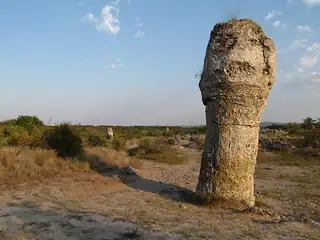
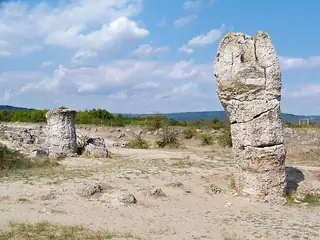
Hollow limestone pillars standing in sand, with no agreement among geologists about how they formed. Fifteen minutes off the motorway and completely unlike anything else on the coast. Half an hour covers the one group with a path round it, so treat it as a stop rather than a destination — and check the day, because it closes on Mondays and Tuesdays.
Story
Background
Stone columns, hollow and filled with sand, stand in loose groups across a belt roughly eight kilometres by three on the western edge of Varna. They are around fifty million years old, from the Lower Eocene, and reach up to six metres with diameters from a third of a metre to three. There are somewhere between seven and fourteen groups depending on who is counting; the one with a path, a ticket booth and a name — Dikilitash — holds about three hundred of them and is the only one most people see.
How they formed has been argued over since a Russian traveller described them in 1829. The old idea that they were coral reefs has been dropped. The explanation that now has the best evidence behind it is stranger: they are tubular concretions that grew around plumes of methane-rich fluid seeping up through the seabed, cemented by microbial activity — a fossilised cold seep, with the carbon chemistry of the cement to back it up.
Two honest notes. The desert is partly man-made: the sand you walk on was exposed by extraction, not by nature. And the site is small. It is a short marked path round one group, and half an hour covers it comfortably — this is a stop on the way to or from Varna rather than a destination. Protected since 1937, which made it the first place in Bulgaria to be given natural-landmark status.
What this kind of place is
Protected area
A protected area under Bulgarian law. What that permits varies enormously by category — a strict reserve may not be entered at all without written permission, while a protected locality is walked and grazed as usual. Check the sign at the boundary rather than assuming.
From open data
Dates and details
- Built
- July 17, 1995
- Municipality
- Varna
- Heritage status
- Tentative World Heritage Site
- Area
- 2.5 km²
English Wikipedia
Pobiti Kamani, tubular concretions formed around "rising methane-bearing fluid plumes", is a desert-like rock phenomenon located on the north west Varna Province border in Bulgaria. The stone pillars were first described by Russian archaeologist and historian Victor Teplyakov in 1829. In order to be preserved, Pobiti Kamani was designated a natural landmark in the late 1930s.
English Wikipedia · CC BY-SA 4.0
Photographs




Where the information comes from
About & sources
Last checked Sep 16, 2026
Descriptions, recommendations and the audio scripts are written for this guide.
Report a problem