


Pleven Panorama
Плевенска епопея
Worth a detour
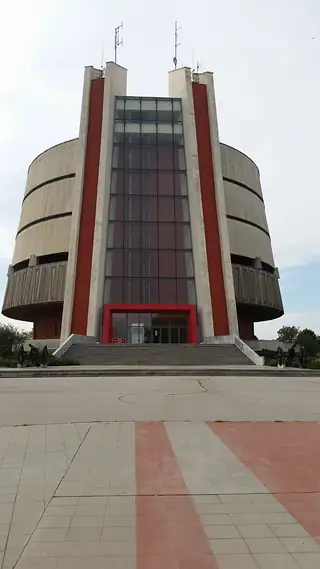
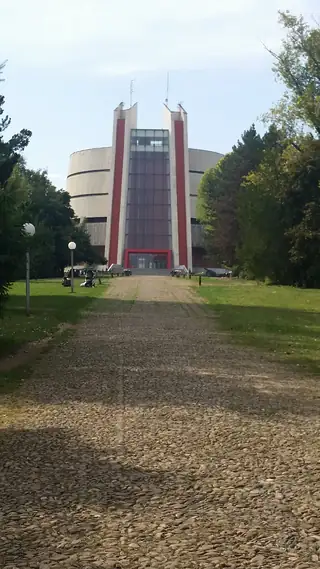
Nikolay Ovechkin and twelve other Russian and Bulgarian painters produced a canvas 115 metres round and 15 high, with a modelled foreground running into it, opened on 10 December 1977 — a hundred years to the day after Osman Pasha surrendered. It stands in Skobelev Park on the ground itself, beside the Kovanlak redoubt. Lifts take you up to roof platforms looking out over the redoubts and the Dead Valley.
Story
Background
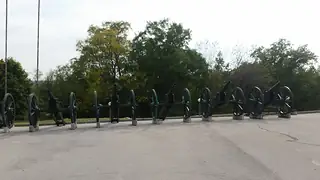
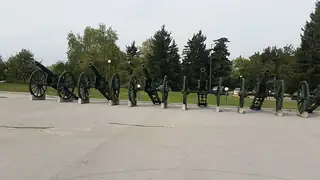
The siege of Pleven ran for five months in 1877 and was the hinge of the Russo-Turkish war. Three assaults on the town failed at enormous cost before a blockade starved it out; Osman Pasha surrendered on 10 December. Pleven has since built something close to two hundred monuments to the Russian, Romanian and Bulgarian dead, and this is the largest of them.
Inside are four spaces. An introductory hall sets up the war; the panorama itself shows the third assault of 11–12 September; a diorama gives the last fighting on 10 December; a closing hall covers the capitulation and the winter crossing of the Balkan range. The painted part is by a team of thirteen led by Ovechkin of the Grekov military studio in Moscow, and the seam between canvas and modelled foreground is genuinely hard to find from the viewing platform, which is the whole trick of a panorama.
The building, by Ivo Petrov and Plamena Tsacheva, is not shy. The drum appears to rest on four bayonets, which carry four horizontal rings: three for the three assaults, and a fourth worked as a frieze for the siege. Two and a half million people came in the first three years. It remains the thing most Bulgarians picture when they hear the word Pleven.
What this kind of place is
Museum
Bulgarian museums outside the capital often keep short hours, close one day a week — Monday most commonly — and shut for lunch. Labels are frequently Bulgarian-only in the smaller ones, and a good many charge separately for the right to photograph.
From open data
Dates and details
- Built
- 1977
- Part of
- 100 Tourist Sites of Bulgaria
- Municipality
- Pleven
- Height
- 47 m
English Wikipedia
Pleven Epopee 1877, more commonly known as Pleven Panorama, is a panorama located in Pleven, Bulgaria, that depicts the events of the Russian-Turkish War of 1877–78, specifically the five-month Siege of Plevna (Pleven Epopee) which made the city internationally famous and which contributed to the Liberation of Bulgaria after five centuries of Ottoman rule. The panorama was created by 13 Russian and Bulgarian artists and was constructed in honor of the 100th anniversary of the Pleven Epopee and was officially unveiled on 10 December 1977.
English Wikipedia · CC BY-SA 4.0
Photographs
Where the information comes from
About & sources
Last checked Sep 16, 2026
Descriptions, recommendations and the audio scripts are written for this guide.
Report a problem


