


Nicopolis ad Istrum
Никополис ад Иструм

Worth a detour
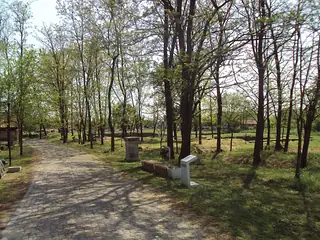
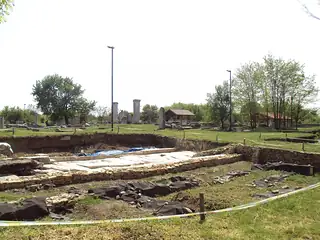
Trajan laid out a proper Greek-speaking city here after the Dacian wars — grid streets, a colonnaded forum, baths, a theatre — the Huns finished it in 447, and crucially nobody ever built on top. You can read an entire Roman town plan at ankle height with nothing later in the way. It is a field of foundations rather than standing walls, so come for the plan, not the drama.
Story
Background
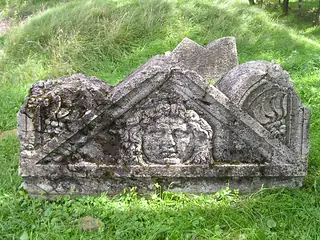
The name is Latin for the city of victory on the Danube, which flatters the geography: the river is a long way north and the site actually sits above the Rositsa. Trajan founded it in the first decade of the second century to mark the end of the Dacian wars and settled it from the Greek-speaking east, which is why the inscriptions here are in Greek rather than Latin. The plan is the textbook orthogonal grid — forum at the centre inside an Ionic colonnade, council building, baths, a theatre, streets running out to the walls.
It did well for itself. Under the Severan emperors the city struck its own bronze coinage in over a thousand recorded types, which is how much of the chronology got dated. In the late 340s the Gothic bishop Wulfila was permitted to settle his converts somewhere in this district, and it was here that he built the Gothic alphabet and translated the Bible into Gothic — the earliest substantial text in any Germanic language came out of these fields.
The Huns destroyed the city in 447. A much smaller walled settlement clung on in one corner through the early Byzantine centuries, then the whole place was abandoned and ploughed rather than rebuilt, which is the reason anything survives. A French archaeologist opened the first trenches in 1900; systematic excavation has run since the 1970s, latterly as a Bulgarian–British project. Bulgaria put the site on the UNESCO tentative list in 1984 and it is still sitting there.
What this kind of place is
Archaeological site
A place where material remains have been recorded. In Bulgaria that can mean anything from a scatter of Roman pottery in a ploughed field to a walled city under excavation. Unless a site has a ticket office, assume there is no sign, no path and no shade.
From open data
Dates and details
- Period
- Roman
- Part of
- 100 Tourist Sites of Bulgaria
- Municipality
- Nikyup
- Heritage status
- Tentative World Heritage Site
English Wikipedia
Nicopolis ad Istrum or Nicopolis ad Iatrum was a Roman and Early Byzantine town. Its ruins are located at the village of Nikyup, 20 km north of Veliko Tarnovo in northern Bulgaria. The town reached its zenith during the reigns of Hadrian, the Antonines and the Severan dynasty.
English Wikipedia · CC BY-SA 4.0
Photographs





Where the information comes from
About & sources
Last checked Sep 17, 2026
Descriptions, recommendations and the audio scripts are written for this guide.
Report a problem