


National Archaeological Museum, Bulgaria
Национален археологически музей

Worth a detour
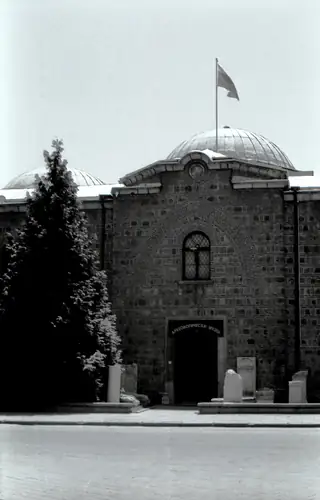
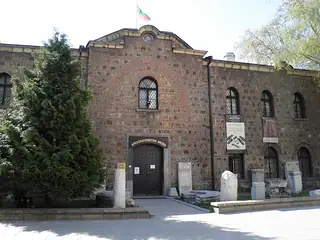
This is the best short argument for why Bulgaria matters archaeologically, and the building is half of it: nine domes on four pillars, the oldest thing still standing in central Sofia. Inside, Thracian metalwork that people travel a long way to see, laid out in one vaulted room you cannot get lost in. An hour is enough, two if the gold holds you.
Story
Background
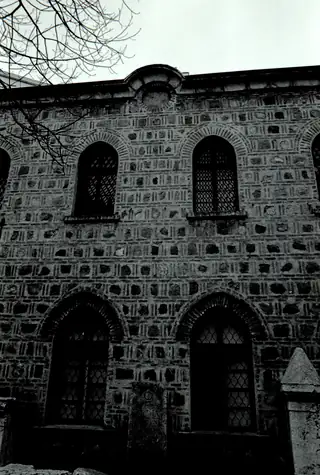
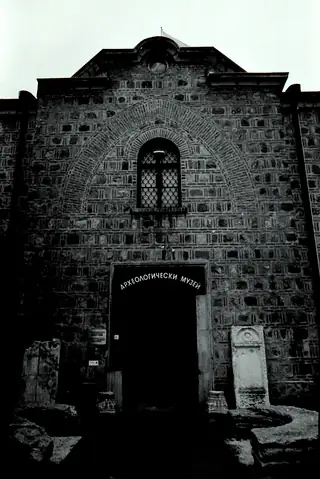
The Büyük — Great — Mosque was begun in 1451 for Mahmud Pasha, then governor-general of Rumelia, and finished in 1494, roughly two decades after he died. It is a square of 36.6 metres a side, roofed by nine domes of equal span carried on four pillars and pointed arches and sheathed in lead. After the war of 1877–78 the abandoned building served as a hospital, then from 1879 as Bulgaria's first national library. The museum was constituted in 1892 and moved its objects in between 1900 and 1905.
The display runs from the earliest traces of human activity found in Europe to the end of the Middle Ages, but the Thracian rooms are what people come for: the Valchitran hoard of thirteen gold vessels, twelve and a half kilograms of it, turned up by two brothers working a vineyard near Pleven in December 1924 and dated to around 1300 BC; the bronze portrait head of the Odrysian king Seuthes III; the Lukovit silver.
It helps to know that this is an institute first and a visitor attraction second — the National Archaeological Institute of the Academy of Sciences happens to have a museum. The emphasis is on the objects rather than on telling you a story about them, which suits some people entirely.
What this kind of place is
Museum
Bulgarian museums outside the capital often keep short hours, close one day a week — Monday most commonly — and shut for lunch. Labels are frequently Bulgarian-only in the smaller ones, and a good many charge separately for the right to photograph.
From open data
Dates and details
- Built
- 1892
- Part of
- Bulgarian Academy of Sciences
- Municipality
- Sofia
- Height
- 10 m
English Wikipedia
The National Archaeological Museum is an archaeological museum in the centre of Sofia, the capital of Bulgaria. It occupies the building of the largest and oldest former Ottoman mosque in the city, originally known as Koca Mahmut Paşa Camii. The construction started in 1451 under grand vizier Veli Mahmud Pasha but due to his death in 1474 the mosque was completed in 1494.
English Wikipedia · CC BY-SA 4.0
Photographs




Where the information comes from
About & sources
Last checked Sep 16, 2026
Descriptions, recommendations and the audio scripts are written for this guide.
Report a problem