


Lake Pomorie
Поморийско езеро

Worth a detour
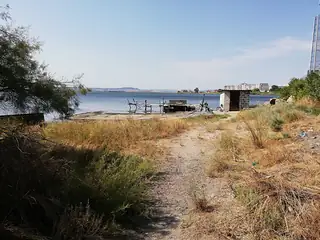
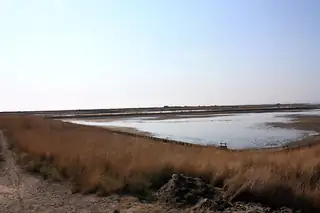
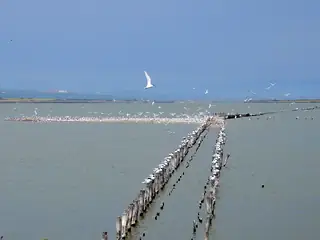
The lagoon behind Pomorie is still divided into evaporation pans and still worked, and that is precisely why the birds are here — bare banks and shallow brine suit terns, avocets and stilts better than any tidied-up reserve would. Green Balkans runs a visitor centre on the south shore with telescopes trained on the colonies. Late spring for nesting, August to October for migration, and winter for the flamingos.
Story
Background
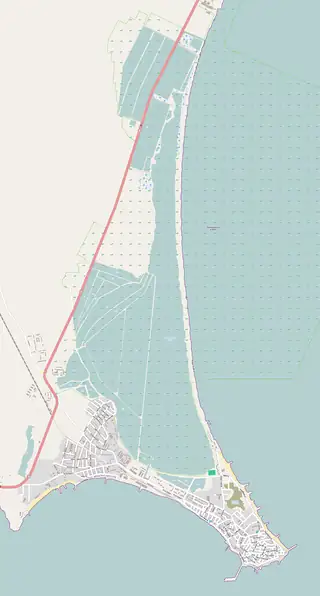
Pomorie was once an island; two sand spits tied it to the land and left this hypersaline lagoon behind — some 8.5 square kilometres of it, rarely more than a metre deep. Salt has been made here for well over two thousand years by the method named after the town's ancient name, Anchialos: sea water admitted at one end, walked slowly through a chain of shallow pans as it concentrates, raked off by hand at the other. The Salt Museum next door, open since 2002, keeps about two hectares of pans working and is the only museum of its kind in south-eastern Europe.
The lagoon became a protected area in 2001 and a Ramsar site in 2002. Its bird list runs to well over two hundred species, and it is one of Bulgaria's main breeding sites for sandwich tern, little tern, avocet, black-winged stilt and shelduck. Since the 2010s greater flamingos have wintered here in numbers that were unthinkable a generation ago.
The visitor centre sits at the southern end beside the Salt Museum: about €2 in, or €3 for both, with a terrace, fieldscopes and an exhibition. It stays open all year, but on winter hours from October, shut on Sundays and Mondays. The sand bar closing the lagoon to the north is a long walk on dark, iron-rich sand — good at dawn, exposed and shadeless by ten.
What this kind of place is
Lake
Most large bodies of still water in Bulgaria are reservoirs built between the 1950s and the 1970s, and the water level in them swings a long way between spring and the end of summer. The genuinely natural lakes are glacial, high in Rila and Pirin, and frozen well into May.
From open data
Dates and details
- Part of
- 100 Tourist Sites of Bulgaria
- Municipality
- Pomorie
- Heritage status
- Ramsar site
- Elevation
- -0.7 m
English Wikipedia
Lake Pomorie is the northernmost of the coastal Burgas Lakes, located in the immediate proximity of the Black Sea and the Bulgarian town of Pomorie. It has an area of 8.5 km2 (reaching 10 km2 together with the adjacent damp zones) and has an elongated shape with a length of 6.7 km and width of 1.8–2 km. Divided from the sea by a narrow strip of sand (spit) and an artificial dike, the lake is an ultrasaline natural lagoon.
English Wikipedia · CC BY-SA 4.0
Photographs




Where the information comes from
About & sources
pomorie-historical-museum.com · 5
- https://pomorie-historical-museum.com/obekti-kam-muzeya/posetitelski-centar-pomoriysko-ezero.html
- https://pomorie-historical-museum.com/posetitelski-centar-pomoriysko-ezero/
- https://pomorie-historical-museum.com/posetitelski-centar-pomoriysko-ezero/ceni-na-vhodni-bileti-pc-pomoriysko-ezero.html
- https://pomorie-historical-museum.com/posetitelski-centar-pomoriysko-ezero/rabotno-vreme-pc-pomoriysko-ezero.html
- https://pomorie-historical-museum.com/filial-muzey-na-solta/
Last checked Sep 17, 2026
Descriptions, recommendations and the audio scripts are written for this guide.
Report a problem