


Lake Mandrensko
Мандра

Worth a detour
Mandra is the third of the Burgas lakes and the one nobody photographs. It was an open, half-salt lagoon connected to the sea until a dam closed it in 1963; the reedbeds and the pelican shallows went and a freshwater reservoir took their place. It is still one of the most important wintering waters in Bulgaria, with counts of pochard and tufted duck in the tens of thousands, and it is best in the months when nobody comes here.
Story
Background
An Ottoman register of 1493 calls it Kyorfez, the bay, and Konstantin Jireček in 1884 described it as ten kilometres long and one to two wide, open to the sea. River corrections and dykes went in during the 1930s; the dam wall followed in 1963. The water surface is now about thirteen hundred hectares, fed by four rivers — the Izvorska, Fakiyska, Sredetska and Rusokastrenska — and it supplies industry and irrigation as well as birds.
What it lost in habitat it partly regained in scale. More than two hundred and fifty species have been recorded; the Mandra–Poda important bird area covers nearly six thousand hectares and lists 245. Winter is the season: pygmy cormorant and Dalmatian pelican, red-breasted goose, white-fronted goose in tens of thousands, and the country's largest counts of whooper and Bewick's swan. Unlike Atanasovsko, it is not a Ramsar site, though it is a Natura 2000 zone under both directives.
The difficulty is access. The lake has industry along its north shore and reeds along the rest, and no visitor infrastructure of its own. Three places work. Poda, at the outflow, has a tower and staff. Lale Bair, a hill on the road from Meden Rudnik towards Tvarditsa, gives the whole sweep of it from eighty-eight metres up. And the mouth of the Izvorska river, a protected site of a hundred and fifty hectares, is a half-hour walk from the village of Dimchevo for those willing to work for it.
What this kind of place is
Lake
Most large bodies of still water in Bulgaria are reservoirs built between the 1950s and the 1970s, and the water level in them swings a long way between spring and the end of summer. The genuinely natural lakes are glacial, high in Rila and Pirin, and frozen well into May.
From open data
Dates and details
- Municipality
- Burgas
- Elevation
- 2 m
- Width
- 1.3 km
English Wikipedia
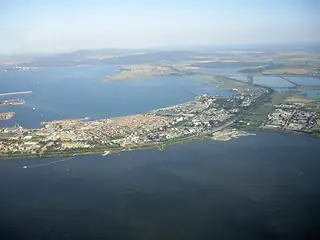
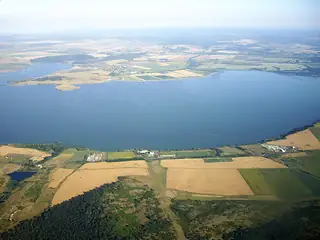
Lake Mandrensko or Lake Mandra is the southernmost of the Burgas Lakes, located in the immediate proximity of the Black Sea and close to Burgas in Bulgaria. Being 9 km long and 1.5 km wide at maximum, as well as having an area of 39.94 km², it was a brackish natural lake until 1963, when it was turned into a reservoir with the construction of a dam to secure fresh water for the large Neftokhim Burgas oil refinery.
English Wikipedia · CC BY-SA 4.0
Photographs




Where the information comes from
About & sources
Last checked Sep 17, 2026
Descriptions, recommendations and the audio scripts are written for this guide.
Report a problem