


Lake Atanasovsko
Атанасовско езеро

Worth a detour
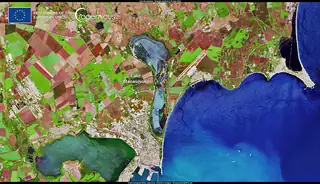
A shallow salt lake split by the road out of Burgas, half of it a strict reserve and half a working saltworks, and the best place in the country to watch migration. In late August something over two thirds of the European white stork population crosses this spot. You can also sit in the free lye and mud pools at the southern end, which is about as Burgas as an afternoon gets.
Story
Background
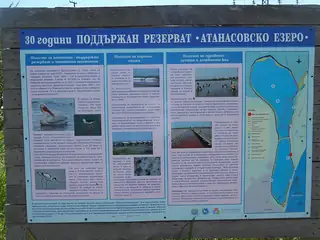
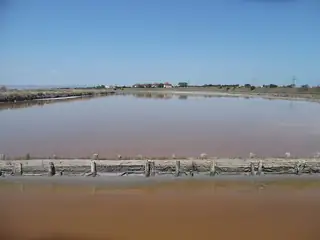
The lake is around 9.5 kilometres long and 4.3 across, and almost nowhere deeper than a metre. Salt has been made here since 1906; roughly 1,690 hectares are still divided into pans, producing something like forty thousand tonnes of sea salt a year. The northern half became a strict reserve in 1980 and a Ramsar site in 1984, and the working and the protected halves have turned out to suit each other — flamingos, avocets and terns want exactly the bare, saline, shallow conditions the industry produces.
The bird list runs to about 316 species, some seventy per cent of everything recorded in Bulgaria, including fourteen that are globally threatened. The reason is the Via Pontica: soaring birds are squeezed between the mountains and the sea and cross here in numbers that are hard to credit until you are standing underneath them. Late August into September is the peak, with white storks, pelicans, honey buzzards and eagles.
Three places to aim for. Tochkata, a raised point on the northern dyke by the saltworks barrier, is the traditional watch point and the one the birders use. A small hide on the western shore, near the petrol station on the Pomorie road, is free but must be booked ahead through the regional environment inspectorate. At the southern end the lye pools and therapeutic mud are open to anyone, free, reachable by car or along the beach — twenty to thirty minutes in the brine is the usual advice, and it is strong stuff.
What this kind of place is
Lake
Most large bodies of still water in Bulgaria are reservoirs built between the 1950s and the 1970s, and the water level in them swings a long way between spring and the end of summer. The genuinely natural lakes are glacial, high in Rila and Pirin, and frozen well into May.
From open data
Dates and details
- Municipality
- Burgas
- Heritage status
- Ramsar site
- Elevation
- 7 m
- Area
- 72 km²
English Wikipedia
Lake Atanasovsko or Lake Atanasovo is a salt coastal lake north of Burgas, Bulgaria, located in direct proximity to the Black Sea. The lake is about 5 km long and divided in two by a strip of sand in the middle. The lake is particularly known for the diversity of its flora and fauna and is surrounded by swamps and canals that drain the whole local basin into the sea.
English Wikipedia · CC BY-SA 4.0
Photographs




Where the information comes from
About & sources
Last checked Sep 17, 2026
Descriptions, recommendations and the audio scripts are written for this guide.
Report a problem