


Holy Forty Martyrs Church
Свети Четиридесет мъченици
Worth a detour
This is the closest thing Bulgaria has to a national reliquary, and it is a small, low, easily missed building at the foot of Tsarevets. Inside are three inscribed stone columns — two ninth-century ones in Greek, brought here deliberately, and Ivan Asen II's own in Bulgarian — and the graves of the medieval dynasty that put them there. Twenty minutes, if you read the columns; ten if you do not.
Story
Background
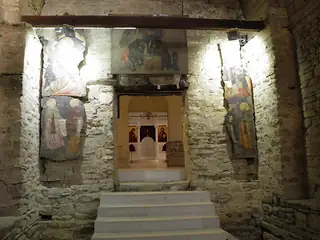
Ivan Asen II built the church after the Battle of Klokotnitsa in March 1230, where he broke the ruler of Epirus and made Tarnovo the dominant power in the Balkans. He recorded the victory himself, carved onto a column that still stands inside. Next to it he set two older stones he had brought in deliberately: a column of Khan Omurtag from the ninth century, its inscription describing a palace on the Danube and then turning, abruptly, to the shortness of a life however grand; and a boundary marker from the reign of Krum. Placing three centuries of Bulgarian rulers in one room was the point.
The graves are the other reason to come. A burial found here in the twentieth century is generally identified as Kaloyan, killed outside Thessaloniki in 1207, and the church is also taken to hold Ivan Asen II and his wife Anna-Maria. For a country whose medieval state was erased for five hundred years, having the bodies and the handwriting in the same building matters more than the architecture does.
Then a second layer: on 22 September 1908 the proclamation ending Bulgaria's formal subordination to the Sultan was read out here, which is why the date and this church are bound together in every school textbook. The building itself has been knocked about, converted, damaged and restored repeatedly, so do not expect thirteenth-century fabric everywhere you look. The columns are the real thing.
What this kind of place is
Orthodox church
An Eastern Orthodox church. Inside, the nave is separated from the altar by an iconostasis — a screen of icons in fixed ranks — and there are usually few or no seats, because Orthodox services are stood through. Shoulders and knees covered; photography is often allowed outside services but flash almost never is, and the rule is worth checking at the door rather than after.
From open data
Dates and details
- Denomination
- Bulgarian Orthodox
- Municipality
- Veliko Tarnovo
- Diocese
- Eparchy of Veliko Tarnovo
- Heritage status
- monument
English Wikipedia
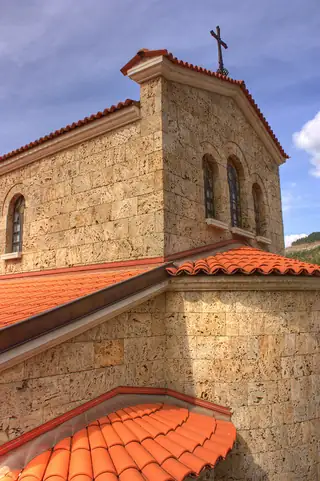
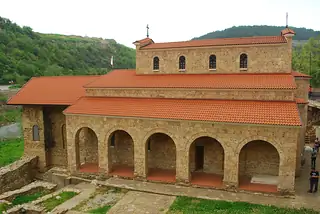
The Holy Forty Martyrs Church is a medieval Eastern Orthodox church constructed in 1230 in the town of Veliko Tarnovo in Bulgaria, the former capital of the Second Bulgarian Empire. The Holy Forty Martyrs Church, an elongated six-columned basilica, has three semicircular apses and a narrow narthex from the west. Another building was added later to the west side of the church.
English Wikipedia · CC BY-SA 4.0
Photographs
Where the information comes from
About & sources
Last checked Sep 17, 2026
Descriptions, recommendations and the audio scripts are written for this guide.
Report a problem


