


Heraclea Sintica
Хераклея Синтика

Worth a detour
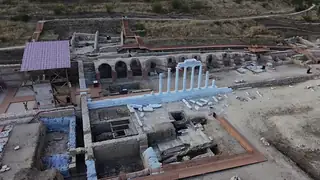
Founded by Philip II in the fourth century BC and only firmly identified in 2002, when a marble slab turned up carrying a letter from the emperors Galerius and Maximinus about the town's lost municipal rights. Digging since 2007 has uncovered the forum, streets and a Roman drain that in 2024 gave up an almost complete marble Hermes. The site reopened to visitors in 2024 after restoration. The statue itself went to Sofia.
Story
Background
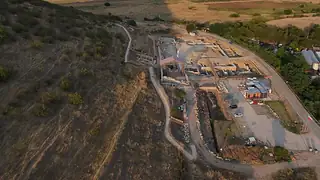
Philip II of Macedon planted a city here in the middle of the fourth century BC, on the southern flank of the Kozhuh — a dead volcano standing out of the Struma plain. It kept going under Rome and did well enough, and then the earthquakes of the late fourth and fifth centuries finished it. For most of the modern period nobody was certain which city it had been.
The answer arrived in 2002 as a marble slab inscribed in Latin: a rescript of the emperors Galerius and Maximinus Daza, dated to 307 or 308, replying to citizens who had petitioned to have their municipal status restored. It named the place. Systematic excavation began in 2007, run by Lyudmil Vagalinski with the Petrich museum, and has been turning up the forum, paved streets and the city's main sewer ever since.
In July 2024 that sewer produced a marble statue of Hermes, over two metres tall and very nearly intact — apparently taken down and buried with some care, which is what a newly Christian city did with an old god rather than smash it. It went to the National Archaeological Institute in Sofia for conservation, so do not come here expecting to see it. What you get instead is a large, legible Roman townscape in the hottest part of the country, with almost nothing in the way of shade.
What this kind of place is
Archaeological site
A place where material remains have been recorded. In Bulgaria that can mean anything from a scatter of Roman pottery in a ploughed field to a walled city under excavation. Unless a site has a ticket office, assume there is no sign, no path and no shade.
From open data
Dates and details
- Built
- 356 BC
- Part of
- 100 Tourist Sites of Bulgaria
- Municipality
- Blagoevgrad
English Wikipedia
Heraclea Sintica, also known as Heraclea Strymonike, was an ancient Greek city located near what is now the village of Rupite in south-western Bulgaria.
English Wikipedia · CC BY-SA 4.0
Photographs


Where the information comes from
About & sources
Last checked Sep 16, 2026
Descriptions, recommendations and the audio scripts are written for this guide.
Report a problem