


Church of the Nativity of Christ in Arbanasi
Рождество Христово

Worth a detour
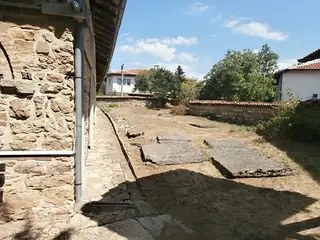
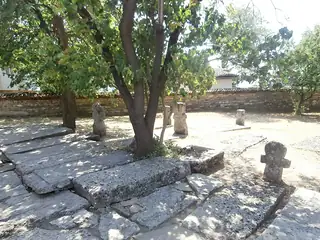
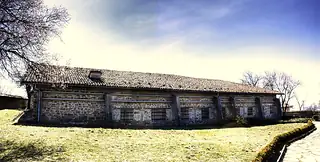
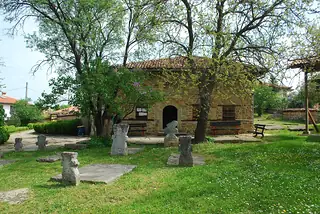
From the lane it is a long, low, half-buried stone shed with no tower and no windows — which was the condition of building a church at all under Ottoman rule. Inside, every surface of the nave, narthex, women's gallery and chapel is painted, in campaigns running from 1597 to 1681. Over two thousand square metres of it. Four kilometres from Veliko Tarnovo and the best half-hour in the area.
Story
Background
Arbanasi sits on the plateau above Veliko Tarnovo, a village of fortified stone houses built by merchant families who had money and privileges and no permission to look as though they did. The Nativity church follows the same logic. It grew in stages — first the naos alone, then a narthex, then a women's gallery, then a chapel of St John the Baptist, all linked by an L-shaped gallery — and stayed deliberately low and blank on the outside throughout.
The painting inside was done across nearly a century, in dated campaigns of 1597, 1632, 1638, 1643, 1649 and 1681, by master painters and workshops drawn from across the Balkans. The effect is not a single scheme but an accumulation: Old and New Testament cycles, the life of Christ, the Virgin, calendar saints, a Last Judgement, and — on the gallery — a frieze of ancient Greek philosophers, Aristotle and the rest, lined up as unwitting witnesses to Christian truth. That convention turns up elsewhere in the Orthodox world but rarely this completely.
The total runs to hundreds of compositions and several thousand figures over more than two thousand square metres, which makes it one of the most thoroughly painted church interiors in the Bulgarian lands. It is also legible in a way many fresco cycles are not: this was a village church, and the programme was designed to be read by people standing in it. Two other Arbanasi churches and a couple of the merchant houses are open on the same ticketing system if you want to make a morning of it.
What this kind of place is
Church
Around four in five Bulgarians who state a religion are Orthodox, and nearly every village church is. Inside, an iconostasis separates the nave from the altar and there are few or no seats, because the services are stood through. Village churches are often locked between services; the key is usually with a neighbour, and asking generally works.
From open data
Dates and details
- Built
- 1597
- Municipality
- Veliko Tarnovo
- Diocese
- Eparchy of Veliko Tarnovo
- Heritage status
- monument
Photographs




Where the information comes from
About & sources
Last checked Sep 16, 2026
Descriptions, recommendations and the audio scripts are written for this guide.
Report a problem