


Church of the Holy Saviour
Свети Спас (Несебър)

Worth a detour
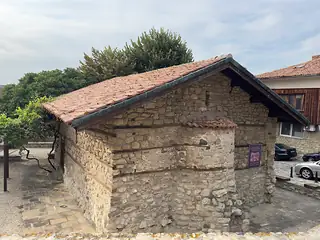
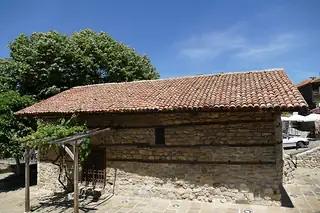
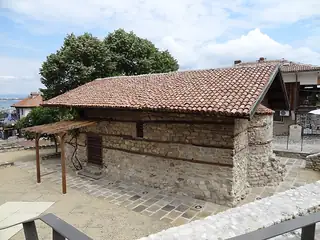
St Spas is the other painted interior in Nesebar and the cheaper one. A single-nave church of 1609, eleven point seven metres by five point seven, built below street level with its eastern facade half in the ground, and frescoed throughout by an anonymous master in the early seventeenth century. Scenes from the life of Christ and the Virgin, with the Virgin Platytera in the apse. About €2.50.
Story
Background
The commemorative inscription above the southern entrance records that a wealthy citizen of Nesebar paid for it in 1609, in the time of Bishop Kiprian, on the ruins of an older church. It is deliberately unassuming from outside — a wooden roof with eaves and no edging, a body dug into the slope — because that was the safe way to build a Christian church under Ottoman rule.
Inside, the painting has survived well. The cycle runs through the life of Christ and the Virgin, with the Virgin Platytera, the orant with the Child in a medallion at her breast, filling the apse. A long narrow narthex once ran along the northern side, taking the total width to nearly ten metres; it is gone.
The church kept, for a long time, the tombstone of Mataissa Cantacuzina, a Byzantine princess buried in Nesebar. It is now in the Archaeological Museum and is one of the better things there. Admission to the church is about €2.50, half that for children, and it is cheaper still as part of a combined ticket — St Stephen and St Spas together cost about €6, and all six museum sites about €18. It is on Briz Street. In winter it opens only if you ask at the museum first.
What this kind of place is
Orthodox church
An Eastern Orthodox church. Inside, the nave is separated from the altar by an iconostasis — a screen of icons in fixed ranks — and there are usually few or no seats, because Orthodox services are stood through. Shoulders and knees covered; photography is often allowed outside services but flash almost never is, and the rule is worth checking at the door rather than after.
From open data
Dates and details
- Denomination
- Orthodox
- Commemorates
- Jesus Christ
- Municipality
- Nesebar
- Diocese
- Sliven Eparchy
English Wikipedia
The Church of the Holy Saviour or Sveti Spas in the UNESCO World Heritage town of Nesebar, Bulgaria, is a 17th-century church building of 1609, 11.70 m long and 5.70 m wide, consisting of a single nave and apse. Although small, it is notable for its early 17th century wall paintings representing scenes from the Life of Christ and the Holy Virgin, with a painting of the Virgin Platytera in the apse. The tombstone of the Byzantine princess Mataissa Cantacuzina, formerly here, is now in the Nesebar Archaeological Museum.
English Wikipedia · CC BY-SA 4.0
Photographs




Where the information comes from
About & sources
Last checked Sep 17, 2026
Descriptions, recommendations and the audio scripts are written for this guide.
Report a problem