


Church of the Holy Mother of God, Plovdiv
„Успение Богородично“

Worth a detour
The largest Orthodox church in Plovdiv, raised by Bratsigovo masons between 1844 and 1852 on merchant money, with a fourteen-metre iconostasis carved by the Stanishev brothers of the Debar school and icons by Nikola Odrinchanin. Its real weight is political: on Christmas Day 1859 the liturgy here was sung in Church Slavonic rather than Greek, a deliberate move in the long fight for a Bulgarian church. Free to enter.
Story
Background
There was probably a Christian sanctuary on this spot as early as the ninth or tenth century, and a church stood here through the Ottoman period. In the 1840s the congregation pulled the old one down and commissioned masons from Bratsigovo, the village whose builders worked across southern Bulgaria, to put up something larger and entirely of stone. The work ran from 1844 to about 1852, funded in large part by the Chalakov brothers, merchants from Koprivshtitsa who had made money in the Ottoman economy and spent a good deal of it on Bulgarian institutions.
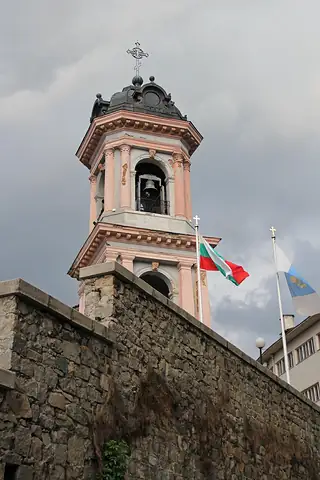
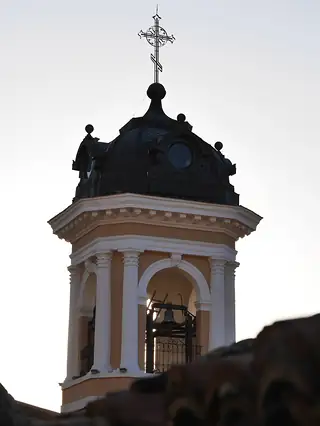
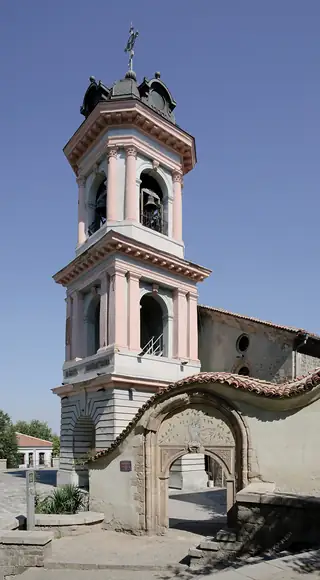
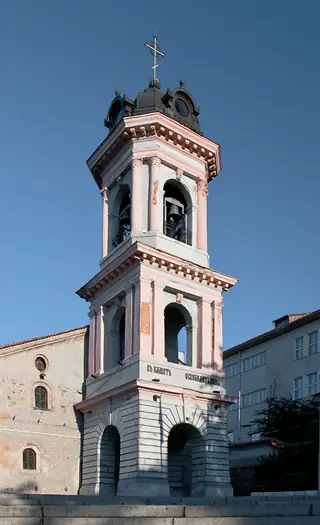
The interior is Revival craftsmanship at its most confident. The iconostasis measures roughly fourteen metres by four and is carved in a restrained Empire manner attributed to Anton and Dimitar Stanishev of the Debar school; most of its icons are by Nikola Odrinchanin. The bell tower outside, with its clock faces, was added in 1881 to a design by Yosif Schnitter, the architect who shaped much of modern Plovdiv.
What happened inside in 1859 matters more than any of it. The Orthodox church in Bulgaria was then under the Greek-speaking Patriarchate of Constantinople, and the language of the liturgy was the argument. On 30 November the Epistle was read here in Slavonic; on Christmas Day the full liturgy followed. Eleven years later a sultan's decree created the Bulgarian Exarchate, and this became its cathedral in Plovdiv.
What this kind of place is
Orthodox church
An Eastern Orthodox church. Inside, the nave is separated from the altar by an iconostasis — a screen of icons in fixed ranks — and there are usually few or no seats, because Orthodox services are stood through. Shoulders and knees covered; photography is often allowed outside services but flash almost never is, and the rule is worth checking at the door rather than after.
From open data
Dates and details
- Built
- 1852
- Denomination
- Orthodox
- Commemorates
- Dormition of the Mother of God
- Municipality
- Plovdiv
- Diocese
- Plovdiv Diocese
- Heritage status
- monument
English Wikipedia
The Church of the Holy Mother of God, officially the Cathedral Church of the Dormition of the Holy Mother of God is a Bulgarian National Revival church in Bulgaria's second largest city Plovdiv. The church is situated in the Old town of Plovdiv on one of the city's seven hills, Nebet Tepe. A small church existed on the site as early as the 9th century.
English Wikipedia · CC BY-SA 4.0
Photographs




Where the information comes from
About & sources
Last checked Sep 17, 2026
Descriptions, recommendations and the audio scripts are written for this guide.
Report a problem