


Church of Saint Paraskevi
Света Параскева

Worth a detour
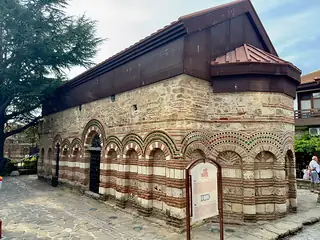
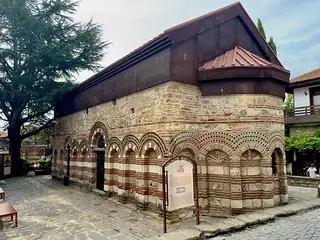
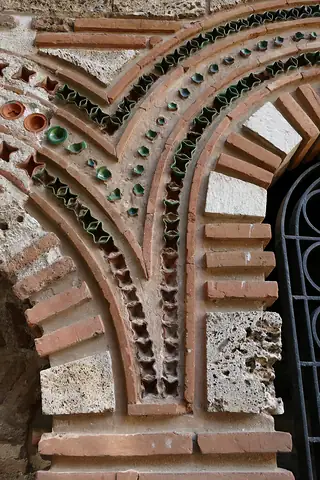
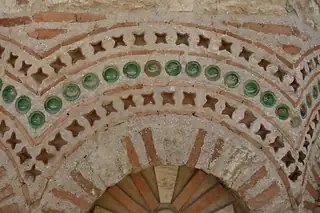
What you are paying two and a half euros for is the outside: two rows of blind arcading, bands of brick alternating with stone, coloured ceramic discs set into the arches, and lunettes filled with herringbone and chequerwork. Inside there is neither dome nor bell tower — both gone — and the space is used as a gallery. Five minutes, unless the pictures detain you.
Story
Background
Most researchers put it in the thirteenth or fourteenth century, though a few argue for much earlier. The plan is simple: a single nave with a narthex at the west end and a five-sided apse at the east, roofed with a barrel vault carried on two arches. The walls use the pseudo-opus mixtum the Nesebar masons preferred, courses of dressed stone alternating with courses of brick and timber lacing buried inside.
The decoration is what makes it. Eight narrow blind arches to a row along the north and south walls and three across the west; archivolts ringed with coloured ceramic rosettes; lunettes filled with brick laid in fish-bone, sun, chequer and zigzag patterns. This is a small provincial church built by people who knew exactly what a kiln could do for them, and it is the clearest example of that skill in a town full of examples.
The dome and bell tower are long gone and a pitched roof covers the nave instead, so the silhouette is wrong and you should read the walls rather than the shape. It opens from April to mid-October along with the other small churches, and outside those months is shown only by arrangement through the archaeological museum.
What this kind of place is
Orthodox church
An Eastern Orthodox church. Inside, the nave is separated from the altar by an iconostasis — a screen of icons in fixed ranks — and there are usually few or no seats, because Orthodox services are stood through. Shoulders and knees covered; photography is often allowed outside services but flash almost never is, and the rule is worth checking at the door rather than after.
From open data
Dates and details
- Built
- 14th century
- Denomination
- Orthodox
- Style
- Byzantine architecture
- Dedicated to
- Paraskeva of the Balkans
- Commemorates
- Paraskeva of the Balkans
- Municipality
- Nesebar
- Diocese
- Sliven Eparchy
English Wikipedia
The Church of Saint Paraskevi is a partially preserved medieval Eastern Orthodox church in Nesebar (medieval Mesembria), a town on the Black Sea coast of Burgas Province in eastern Bulgaria. It was most likely built in the 13th or 14th century and forms part of the Ancient Nesebar UNESCO World Heritage Site. The Church of Saint Paraskevi features a single nave and a pentagonal apse as well as rich exterior decoration.
English Wikipedia · CC BY-SA 4.0
Photographs




Where the information comes from
About & sources
Last checked Sep 17, 2026
Descriptions, recommendations and the audio scripts are written for this guide.
Report a problem