


Church of Christ Pantocrator
Христос Пантократор
Worth a detour
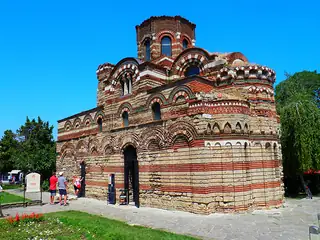
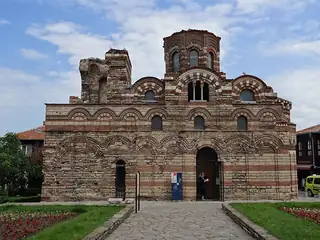
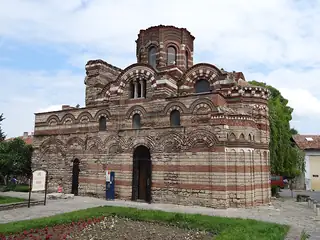
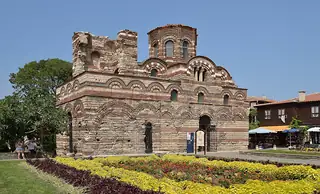
Pantocrator is the picture everyone takes home from Nesebar and deserves to be. Thirteenth or fourteenth century, sixteen metres by not quite seven, with three profiled apses, a bell tower over the narthex and facades worked in tall blind arches, rows of glazed ceramic saucers and four-leafed flowers, and a brick swastika frieze running above the east end. Look at the outside; the inside is largely bare.
Story
Background
The plan is rectangular with two doors, south and west, and four columns in the nave that once carried a dome now gone. A stone stair built inside the wall between nave and narthex led up to the rectangular bell tower. A medieval tomb lies under the narthex floor. The drum is richly decorated and pierced by eight arched windows.
What makes the building is the surface. Nesebar's late churches are the high point of a Balkan style that treats a wall as something to embroider: courses of white stone and red brick alternating, blind arcades whose tympana are filled with zigzag and chequerboard, and glazed ceramic discs set into the masonry so that the whole thing catches the light. The swastika frieze over the apses is a solar motif and has nothing to do with the twentieth century.
Inside, only traces of the original painting survive, and the space is used for exhibitions — most recently a display of eighteen maps of Nesebar and the bay from the fourth to the nineteenth century. That exhibition is described as open daily until the end of October, but the church does not appear in the museum's price list or its published opening hours, so ask at the Archaeological Museum rather than relying on finding it open. It stands on Mitropolitska Street in the middle of the old town, on the walk everybody takes.
What this kind of place is
Orthodox church
An Eastern Orthodox church. Inside, the nave is separated from the altar by an iconostasis — a screen of icons in fixed ranks — and there are usually few or no seats, because Orthodox services are stood through. Shoulders and knees covered; photography is often allowed outside services but flash almost never is, and the rule is worth checking at the door rather than after.
From open data
Dates and details
- Denomination
- Orthodox
- Style
- Byzantine architecture
- Commemorates
- Jesus Christ
- Municipality
- Nesebar
- Diocese
- Sliven Eparchy
English Wikipedia
The Church of Christ Pantocrator is a medieval Eastern Orthodox church in the eastern Bulgarian town of Nesebar (medieval Mesembria), on the Black Sea coast of Burgas Province. Part of the Ancient Nesebar UNESCO World Heritage Site, the Church of Christ Pantocrator was constructed in the 13th–14th century and is best known for its lavish exterior decoration. The church, today an art gallery, survives largely intact and is among Bulgaria's best preserved churches of the Middle Ages.
English Wikipedia · CC BY-SA 4.0
Photographs
Where the information comes from
About & sources
Last checked Sep 17, 2026
Descriptions, recommendations and the audio scripts are written for this guide.
Report a problem


