


Central Synagogue of Sofia
Софийска синагога
Worth a detour
Consecrated in 1909 for a community descended from Jews expelled from Spain and settled across the Ottoman Balkans, and built for well over a thousand worshippers. The Viennese brass chandelier is the largest in the country. Upstairs is a small museum that includes the reason Bulgaria's own Jews were not deported. Go on a weekday — it shuts for two sets of holidays.
Story
Background
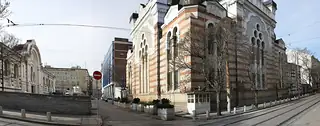
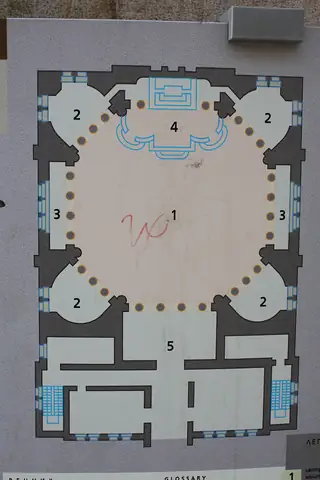
Friedrich Grünanger designed it, worked on it from 1905, and delivered a Spanish-Moorish building with Viennese Secession detailing. It was dedicated on 9 September 1909 in front of King Ferdinand and the prime minister. The main hall is octagonal, the dome nineteen metres across and twenty-three to the inside of its crown, thirty-one metres to the top outside; there are 1,170 seats in the prayer hall. The mosaic is Venetian, the columns Carrara marble, the joinery Slavonian oak, and the chandelier came from Vienna. A bomb struck the north-east corner on 13 April 1944 and failed to explode, but the shock took out the stained glass.
The museum on the upper floor holds two permanent displays, on the Jewish communities of Bulgaria and on the Holocaust. The second carries a story with two halves that have to be told together. The roughly fifty thousand Jews living inside Bulgaria's pre-war borders were never put on the trains: deputy speaker Dimitar Peshev's revolt in parliament on 19 March 1943, backed by senior Orthodox clergy and by public protest, forced the deportations to be cancelled. At the same time, more than eleven thousand Jews from the territories Bulgaria occupied in Aegean Thrace and Vardar Macedonia were handed to the Germans and murdered at Treblinka.
The congregation today is a fraction of the one this room was sized for. That is also part of what you are looking at.
What this kind of place is
Synagogue
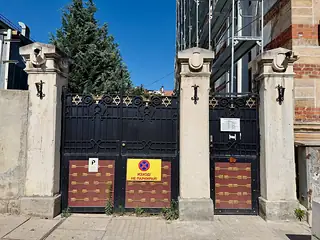
Bulgaria has very few working synagogues, and the reason is worth knowing: the country's roughly 48,000 Jews were not deported during the Second World War, but most emigrated to Israel after 1948, and the congregations that remained were small. Several surviving buildings are now concert halls or galleries. Where one is still in use, security at the door is normal and bringing a passport saves an argument.
From open data
Dates and details
- Built
- September 9, 1909
- Architect
- Friedrich Grünanger
- Style
- Moorish Revival architecture
- Part of
- 100 Tourist Sites of Bulgaria
- Municipality
- Sofia
- Height
- 31 m
English Wikipedia
The Sofia Synagogue is a Romaniote Orthodox Jewish congregation and synagogue, located in Sofia, Bulgaria. Completed in 1909, the synagogue is the largest synagogue in Southeastern Europe, the third-largest in Europe, and one of two active synagogues remaining in Bulgaria. Despite the building's size, the services are normally only attended by some 50 to 60 worshippers due to the aliyah of most of Bulgaria's Jews to Israel and the secularity of the local Jewish population.
English Wikipedia · CC BY-SA 4.0
Photographs
Where the information comes from
About & sources
Last checked Sep 16, 2026
Descriptions, recommendations and the audio scripts are written for this guide.
Report a problem


