


Burgas Lakes
Бургаски влажни зони

Worth a detour
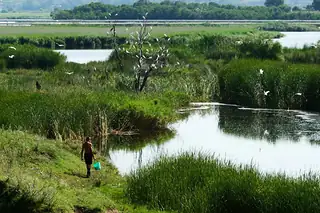
No other European city of this size has four internationally listed wetlands inside its ring road. Vaya to the west, Atanasovsko to the north, Mandra to the south and Poda where the last of them meets the sea, with a working saltworks in the middle of it. Three of the four are Ramsar sites. In late August the storks come over in numbers that stop conversation. You do not need to be a birdwatcher, only to be here at the right time.
Story
Background
The reason is geography. Soaring birds will not cross open water if they can help it, and the Black Sea pushes the autumn migration of eastern Europe into a corridor between the mountains and the coast — the Via Pontica, which Ramsar calls the second largest flyway in Europe. Burgas sits in the narrowest part of it, and the wetlands the birds need happen to be here too.
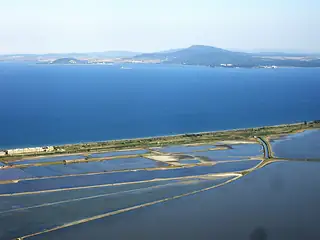
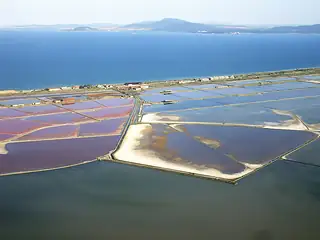
The four are different in kind, which is why the bird lists differ. Vaya, west of the city, is the largest natural lake in Bulgaria, brackish and shallow, with 240 species on its Ramsar record. Atanasovsko, north, is hypersaline and divided into salt pans, 1,995 hectares listed since 1984 with 317 species. Mandra, south, was an open sea-lagoon until a dam closed it in 1963 and turned it into a freshwater reservoir; it is not a Ramsar site but the Mandra–Poda bird area covers nearly six thousand hectares and holds 245 species. Poda, the small strip where Mandra drains to the sea, has 321 species recorded on about a square kilometre.
In practice a visitor uses three places. Poda for the colony and the staff who will name what you are looking at. Tochkata, on the northern dyke at Atanasovsko, for the migration itself. The southern salt pans at Atanasovsko for the lye pools, which is bathing rather than birding. Add Lale Bair above Mandra for the view and you have a full day without leaving the municipality.
From open data
Dates and details
- Elevation
- 0 m
English Wikipedia
The Burgas Lakes or Burgas Wetlands are a group of coastal lakes of varying saltiness located around the Bulgarian city of Burgas in the proximity of the Black Sea. They constitute the largest group of lakes in the country and comprise some of Bulgaria's biggest and most important lakes.
English Wikipedia · CC BY-SA 4.0
Photographs




Where the information comes from
About & sources
Last checked Sep 17, 2026
Descriptions, recommendations and the audio scripts are written for this guide.
Report a problem