


Boyana Church
Боянска църква

Worth a detour
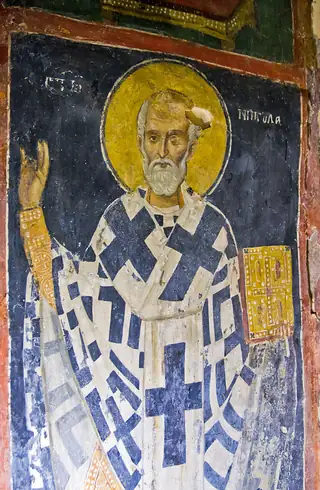
The 1259 frescoes here show individual faces with individual expressions — realism that Western Europe generally credits to the early Renaissance, painted by an anonymous master on the edge of Sofia. You get only a few minutes inside, with good reason, and it is still worth the trip. Nine people at a time, ten minutes, ten euros — work out whether that maths suits you before you come.
Story
Background
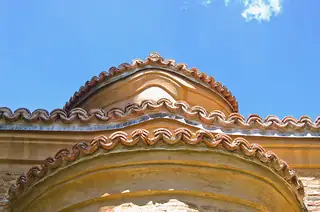
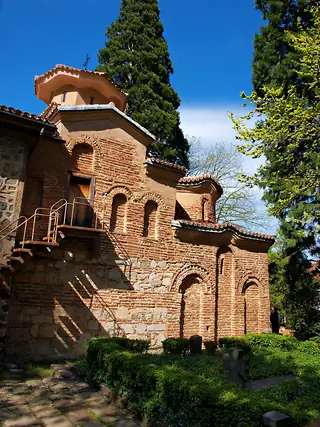
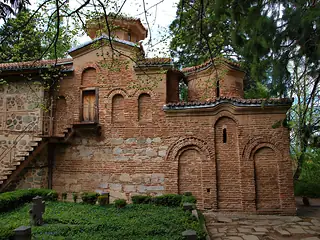
The building is three churches stuck together. The small eastern chamber went up around the turn of the eleventh century; a two-storey extension was added in the middle of the thirteenth by a local governor, the sebastocrator Kaloyan, and his wife Desislava; a plainer western section was tacked on much later. The whole thing would be unremarkable from the outside if you did not know what was inside.
What is inside is the 1259 layer: eighty-nine scenes and two hundred and forty figures, including Kaloyan and Desislava themselves, handing over a model of their church. The faces are the reason people come. They are not the stock Byzantine types — they are particular people, with particular expressions, modelled in light and shade, and they were painted half a century before Giotto's Scrovegni Chapel. Nobody knows who did it.
The church was shut for conservation in 1954 and only came fully back in 2008. The air is controlled now, which is why nine of you go in for ten minutes and then come out again. It is a short visit for the money, and the upper chapel is currently closed for further conservation work. Read about the frescoes before you arrive — you will not have time to work them out in front of them.
What this kind of place is
Orthodox church
An Eastern Orthodox church. Inside, the nave is separated from the altar by an iconostasis — a screen of icons in fixed ranks — and there are usually few or no seats, because Orthodox services are stood through. Shoulders and knees covered; photography is often allowed outside services but flash almost never is, and the rule is worth checking at the door rather than after.
From open data
Dates and details
- Built
- 10th century
- Denomination
- Bulgarian Orthodox
- Dedicated to
- Saint Nicholas
- Commemorates
- Saint Nicholas
- Part of
- 100 Tourist Sites of Bulgaria
- Municipality
- Sofia
- Diocese
- Sofia Eparchy
- Heritage status
- World Heritage Site
- Area
- 6,800 m²
English Wikipedia
The Boyana Church is a medieval Bulgarian Orthodox church situated on the outskirts of Sofia, the capital of Bulgaria, in the Boyana quarter. In 1979, the building was added to the UNESCO World Heritage List. The east wing of the two-story church was originally constructed in the late 10th or early 11th century, then the central wing was added in the 13th century under the Second Bulgarian Empire, the whole building being finished with a further expansion to the west in the middle of the 19th century.
English Wikipedia · CC BY-SA 4.0
Photographs




Where the information comes from
About & sources
Last checked Sep 17, 2026
Descriptions, recommendations and the audio scripts are written for this guide.
Report a problem