


Abritus
Абритус

Worth a detour
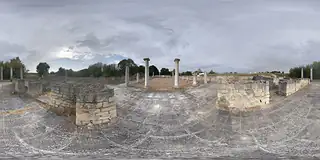
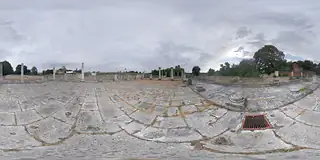
In 251 a Gothic army destroyed a Roman field force in the marshes near here and killed the emperor Decius together with his son — usually counted as the first Roman emperor to die fighting a foreign enemy. That happened about fifteen kilometres away. What you can actually walk is the city: a full circuit of Constantinian wall, four gates, and the footprint of a courtyard building with twenty-five shops along the main street.
Story
Background
Abritus started as a Thracian settlement, became a Roman military camp in the first century and a town in the second. Its best years were the fourth to sixth centuries, when it was walled, watered by clay aqueducts and important enough to have a bishop — one named Marcian is recorded around 458. The defences you see went up under Constantine the Great: some 1,400 metres of circuit, two to three metres thick, standing up to twelve metres, with four gates and a ring of towers. The Avars destroyed it in 586; a Bulgarian village grew on the ruins and lasted until about the tenth century.
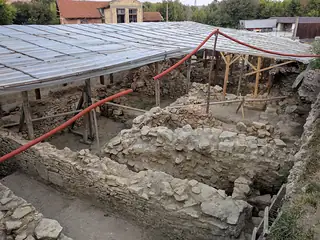
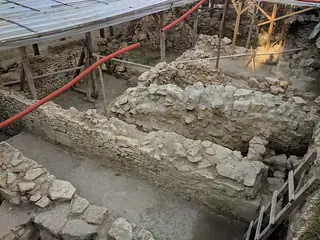
The modern site is a hundred hectares of reserve with the ancient town, fifteen hectares of it, at the centre. Excavation began properly in 1953 under Teofil Ivanov, who in 1954 matched the ruins at Hisarlaka to the Abritus known until then only from documents. He and his successors uncovered the wall circuit, the gates, a grid of streets and a large courtyard house of roughly three thousand square metres with twenty-five shops off it, fronted by a colonnade forty-one metres long.
Two finds carried the site's name further: a gilded Pegasus, and a hoard of 835 fifth-century gold coins buried just inside the eastern wall — the largest late-Roman gold hoard found in Bulgaria, probably hidden during a Gothic raid by someone who did not come back for it.
What this kind of place is
Archaeological site
A place where material remains have been recorded. In Bulgaria that can mean anything from a scatter of Roman pottery in a ploughed field to a walled city under excavation. Unless a site has a ticket office, assume there is no sign, no path and no shade.
From open data
Dates and details
- Part of
- Moesian Limes
- Municipality
- Razgrad
English Wikipedia
Abritus or Abrittus was an impressive Roman walled city and one of the biggest urban centres in the province of Moesia Inferior. Its remains are in the Archaeological Park of Razgrad.
English Wikipedia · CC BY-SA 4.0
Photographs




Where the information comes from
About & sources
Last checked Sep 16, 2026
Descriptions, recommendations and the audio scripts are written for this guide.
Report a problem